
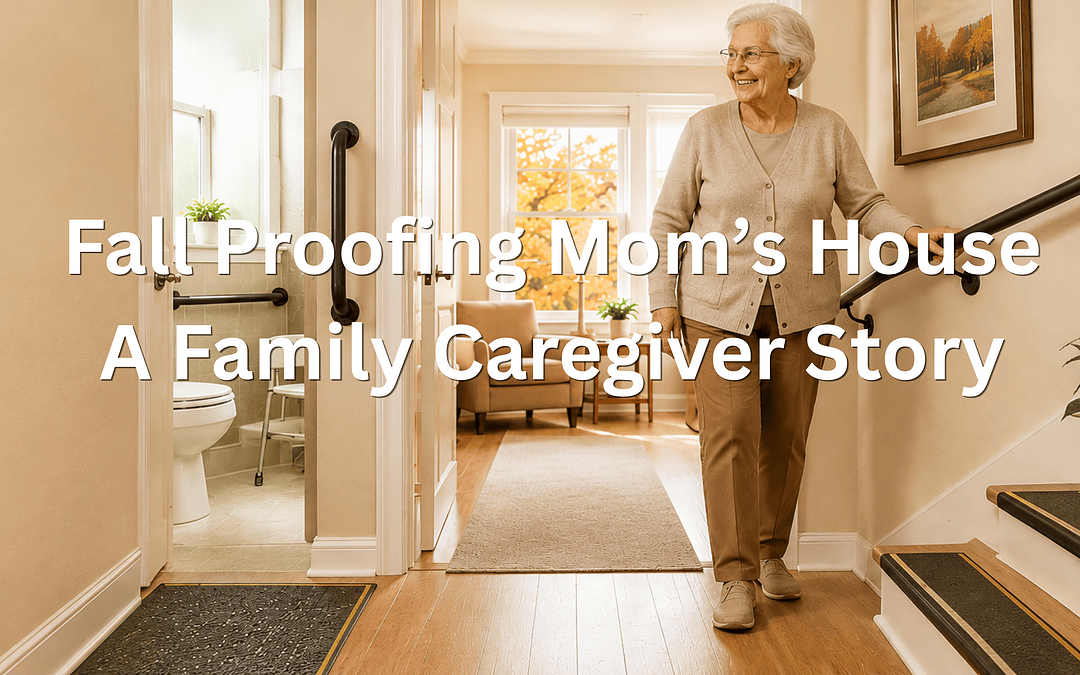
I want to start with the part nobody told me when I became my mom’s caregiver: you can do this. I’m not a nurse. I’m not an occupational therapist. I’m just a daughter who spent years helping my mom stay in the house she’d lived in since 1979, and the thing I learned fastest is that most of what keeps an older person safe at home isn’t medical. It’s practical. It’s a grab bar in the right spot. It’s a lamp that turns on by itself at 2 a.m. It’s noticing the rug your mom has walked across ten thousand times is now the single most dangerous object in her life.
If you’re reading this you might be scared mom or dad is going to fall, or because they already did and you’re trying to make sure it never happens again, I’ve been exactly where you are.
Let me tell you how we did it.
The night that changed how I saw her house
My mom called me at 11 p.m. on a random Tuesday evening. She’d gotten up to use the bathroom, caught her foot on the edge of the hallway runner, and grabbed the towel bar on the way down. The towel bar came off the wall. She landed on her hip. By some miracle nothing broke, but she sat on that cold tile floor for almost forty minutes before she could get herself up, because she’d left her phone charging in the kitchen.
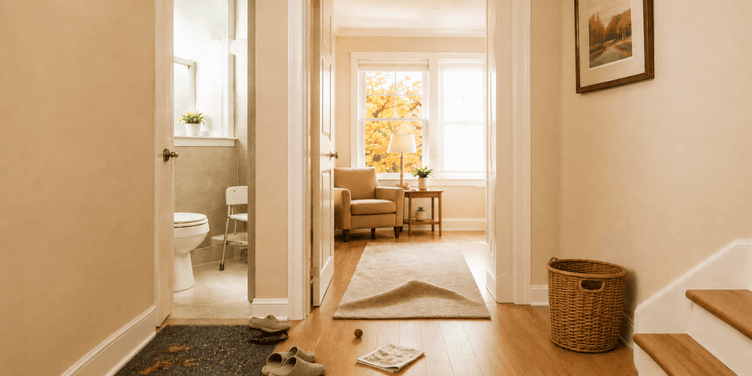
I drove over that night and I remember standing in her hallway at midnight, looking at the house I grew up in like I’d never seen it before. The runner I’d walked across my whole childhood. A bathroom with nothing to hold onto but a towel bar that was never meant to hold a human being. The burned-out bulb in the hall fixture she’d been “meaning to get to.” None of it had been a problem when she was sixty. At eighty-three, every one of those things was waiting to hurt her.
So the next weekend, my brother and I did something I wish we’d done years earlier. We walked through the entire house using a home safety checklist, room by room, and we asked one question over and over: if Mom got dizzy right here, what would happen? That question changed everything. We weren’t looking for what was broken. We were looking for what was risky. There’s a difference, and once you start seeing your parent’s home that way, you can’t un-see it.
Mom’s House Before.
What we actually changed
Here’s the part I want you to be able to use. We didn’t gut the house or spend a fortune, aging in place doesnt start with spending, it starts with planning. Most of what made the biggest difference cost very little and took a weekend. If you do nothing else, work through this list:
- Remove loose rugs. Loose rugs and runners are the number one tripping hazard in most homes. We rolled hers up and donated them. The bare floor felt strange to her for a week, then she forgot they were ever there.
- Add lighting everywhere to avoid night time falls. We put in brighter bulbs, added plug-in motion-sensor nightlights in the hallway and bathroom, and made sure she never had to cross a dark room to find a switch. Most nighttime falls happen on the way to the bathroom.
- Anchor Sturdy Grab Bars Where Needed. Towel bars do not count. Avoid buying the silly suction-cup ones. You need properly mounted grab bars by the toilet and inside the shower. This is the single best money we spent. If you’re not handy, a handyman can do it in an afternoon.
- Add a shower chair and a non-slip mat in the tub. Standing on one foot to wash the other is how a lot of people go down. A simple shower chair takes that risk away and, honestly, she found showering less exhausting too.
- Raise the toilet seat or switch to a comfort-height toilet. Getting up from a low seat is hard on aging hips and knees, and that struggle is a fall waiting to happen. A raised seat with handles made her far more independent in the bathroom.
- Add handrails on both sides of every set of stairs. Most homes have a rail on one side. Two sides means she had something to hold no matter which way she was going, up or down.
- Clear walkways and tape down loose cords. We widened the paths through every room, moved furniture that crowded the routes she used daily, and ran lamp and phone cords along the walls so nothing snaked across the floor.
- Move everyday items to waist height. Reaching up to a high shelf or bending to a low cabinet invites a fall. We rearranged her kitchen so the things she used every day were all between her shoulders and her hips. No more step stool.
- Add a sturdy chair or bench near front door for putting on shoes. Balancing on one foot in the entryway, leaning against the wall, is risky. A solid seat by the door fixed that, and we got her proper non-slip shoes she actually wore instead of loose slippers.
- Consider a medical alert device. After that night on the bathroom floor, this was non-negotiable for us. A pendant or watch she wears all day means that if she ever does go down, help is one button away and she’s never stuck alone for forty minutes again.
That list covers the big ones. Your parent’s home will have its own quirks, and you’ll spot them once you start walking through with that “what if they got dizzy here” question in your head.
Why I wish we did a real assessment before the first fall.
Here’s my one regret. While moom was ok, from her initial fall. I have talked with many people that have had an elderly parent trip and fall and cause serious harm or worse on the first time they had a stumble.
We figured a lot of this out the hard way, one near-miss at a time, fixing things only after they scared us. Ended up buying a couple of products that didn’t fit her situation and sat in a closet. We missed a few things a professional would have caught immediately.
A proper home safety assessment looks at the whole picture at once: your parent’s actual physical abilities, the specific layout and hazards of their home, what they can afford, and what they’re actually willing to use. Then it tells you which changes matter most for this person in this house and which products and services are genuinely worth the money. It’s the difference between guessing and knowing.
Because the truth is, no two situations are the same. Grab bars matter enormously for one person and barely register for another whose real risk is the stairs, or the lighting, or the fact that she can’t safely carry laundry to the basement anymore. An assessment sorts the urgent from the nice-to-have, and it points you toward the right products and services instead of leaving you to buy things off a list and hope. If I could go back, I’d have started there, before I spent a dollar.

You can do this
If you’re the one your family is counting on to keep Mom or Dad safe at home, I want you to know it’s absolutely within reach. Start with the walkthrough. Get an assessment if you can. Knock out the list. And give yourself credit, because what you’re doing is hard and it matters more than almost anything else you’ll do this year.
You’ve got this. I promise.